
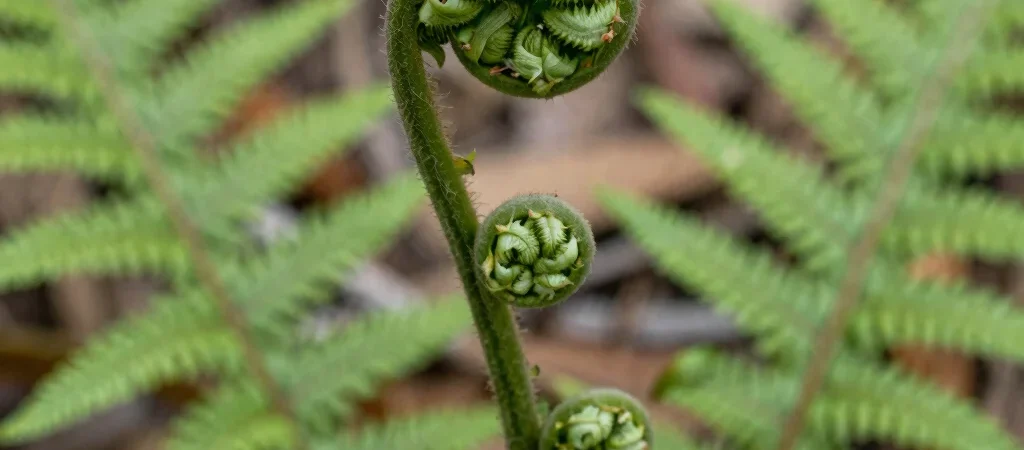
A young fern frond has a way of looking both delicate and determined. Its tight coil holds a pattern that vanishes as it opens, so the useful moment is not simply “spring” but the brief stretch when the new growth is still curled. I slow down here, because a few steps can make the difference between seeing it and walking past.
Find a clear shape
The curl reads best when it has room around it. I look for one frond set against a darker leaf or a softly blurred patch of ground, rather than trying to include every stem in the cluster. A small change in viewpoint can separate the spiral from the busy lines behind it.
Notice what surrounds it
The plants around a fern tell part of the seasonal story. Last year’s brown fronds may still lie under the new growth, while fresh leaves nearby are only beginning to spread. Including a little of that context can make the photograph feel like a place, not a botanical specimen lifted out of its surroundings.
Return as it changes
A single visit records one stage; returning a few days later shows how quickly the coil loosens and the frond changes direction. I like to keep the framing similar when I can, because small differences become easier to notice. The practical takeaway is simple: when you find a young fern worth photographing, make a note of the spot and come back.